
Peptide Synthesis Methods
Searches for peptide synthesis methods usually aim to understand how short amino acid sequences are assembled, purified, and verified. This page provides a practical educational walkthrough of the core workflow used in modern research settings, especially solid-phase peptide synthesis (SPPS).
Primary resources for this topic
Use this walkthrough to understand the sequence of events, then verify process claims with source-level documentation.
- PubMed search: solid-phase peptide synthesis reviews.
- PubMed search: peptide purification and HPLC reviews.
- Lot-specific COAs, HPLC traces, mass confirmation, and handling instructions when you compare research-use vendors.
Why SPPS Became the Standard
Solid-phase peptide synthesis (SPPS) is widely used because it supports stepwise chain assembly while the growing peptide remains attached to a solid resin. This allows repeated reaction and wash cycles with comparatively efficient handling and better process control than many older solution-only workflows.
The method generally uses protected amino acid building blocks, coupling reagents, and deprotection steps until the full sequence is assembled. After sequence completion, the peptide is cleaved from the resin and side-chain protections are removed.
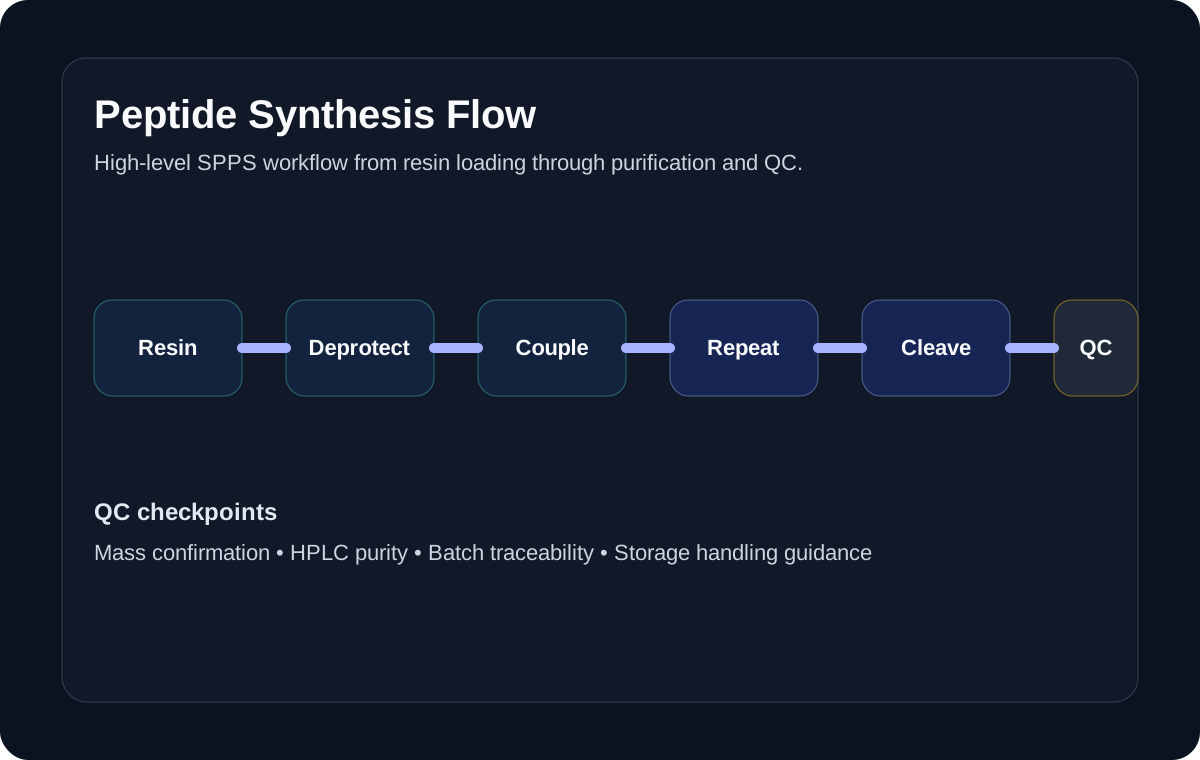
Typical Peptide Synthesis Flow (High-Level)
Anchor the initial residue or linker to a compatible resin support.
Remove temporary protecting group (often Fmoc strategy) to expose the reactive amine.
Add the next protected amino acid with coupling chemistry designed to drive bond formation.
Iterate deprotection/coupling until target sequence length is reached.
Release peptide from resin and remove side-chain protections.
Use chromatographic purification and confirm identity/purity by analytical methods.
Purification and QC: Where Quality Is Confirmed
Raw crude product after cleavage often contains truncated or modified species. Purification is therefore essential in most workflows. Reverse-phase HPLC is a common method to separate target peptide from impurities based on hydrophobic behavior.
Typical QC checks
- Mass confirmation: Verify molecular weight by mass spectrometry.
- Purity profile: Measure chromatographic purity percentage (method-dependent).
- Identity consistency: Confirm expected retention and spectral signatures across runs.
In educational and sourcing contexts, this is why reputable providers emphasize COA-style documentation: it gives a transparent view of identity and purity claims.
Common Method Variables Researchers Watch
Sequence complexity
Longer or aggregation-prone sequences can reduce coupling efficiency and increase side-product risk.
Protecting-group strategy
Protecting chemistry choices affect side reactions, deprotection conditions, and final cleanup complexity.
Purification burden
Even with strong coupling efficiency, purification demands can vary significantly depending on sequence and process parameters.
Storage and handling after synthesis
Stability can depend on residue composition, moisture exposure, temperature, and formulation state. Documentation and handling controls matter for reproducibility.
Where Synthesis Projects Commonly Fail
Most peptide workflows fail in predictable places: incomplete coupling, aggregation-prone sequences, harsh deprotection side reactions, and weak purification strategy planning. These are process risks, not just chemistry trivia, because each risk changes downstream interpretation of assay data and can produce misleading biological conclusions.
Educational content is stronger when it explains failure mode plus mitigation in one place. If coupling efficiency drops, teams may use double coupling or altered solvent systems. If hydrophobic sequences aggregate, they may adjust resin choice, temperature, or fragment strategy. If crude quality is poor, purification burden rises and final yield can fall sharply.
- Coupling inefficiency: Raises deletion-sequence impurity risk.
- Aggregation during chain growth: Can suppress reaction accessibility.
- Over-aggressive cleavage/deprotection: May create side products that complicate QC.
- Under-scoped purification planning: Delays timelines and increases cost per usable milligram.
Understanding these risks helps readers evaluate supplier claims and method sections with more precision.
Documentation Checklist for Vendor or Lab Comparison
When choosing a synthesis partner or evaluating internal process quality, ask for method-level documentation rather than headline purity alone. Two peptides can both show high stated purity while differing significantly in identity confidence, impurity profile, and reproducibility across lots.
- Analytical method details: HPLC method conditions and integration approach.
- Identity confirmation: Mass spec data that matches expected molecular weight.
- Batch traceability: Lot identifiers tied to raw analytical outputs.
- Storage/handling instructions: Practical stability guidance after receipt.
Use this page with the Essential Amino Acids Guide for residue-level context and Peptide vs Protein for broader structural framing.
FAQ: Peptide Synthesis Search Intent
Is SPPS the only peptide synthesis method?
No. It is the dominant modern approach for many sequences, but alternative or hybrid methods may be used depending on project requirements.
Does high purity guarantee biological effect?
No. Purity and identity are quality foundations, but functional outcomes depend on assay design, target biology, concentration, and experimental controls.
Why do method details matter for SEO content quality?
Because users searching this topic want practical clarity, not vague marketing language. Detailed, accurate explanations better match user intent and improve topical authority.
What is reverse-phase HPLC typically used for in synthesis workflows?
It is commonly used to separate target peptide from impurities based on hydrophobic behavior.
Why is deprotection used during SPPS cycles?
Temporary deprotection removes groups (often using Fmoc chemistry) to expose the reactive amine for the next coupling step.