
Peptide vs Protein: What Is the Real Difference?
The peptide vs protein question is one of the most common search intents in molecular biology. Both are chains of amino acids, but they differ in scale, structure, and the way scientists analyze them in the lab. This guide gives a practical framework you can apply when reading research papers, protocols, and product documentation.
Primary resources for this topic
Use this page as a plain-language overview, then verify terms and claims with primary sources.
- PubMed Central for literature on peptide signaling, protein structure, and assay context.
- PubMed search: peptide, protein, structure, and folding reviews.
- Lot-specific COAs and HPLC or mass data when a vendor listing uses peptide or protein terminology loosely.
Quick Comparison Table
| Category | Peptide | Protein |
|---|---|---|
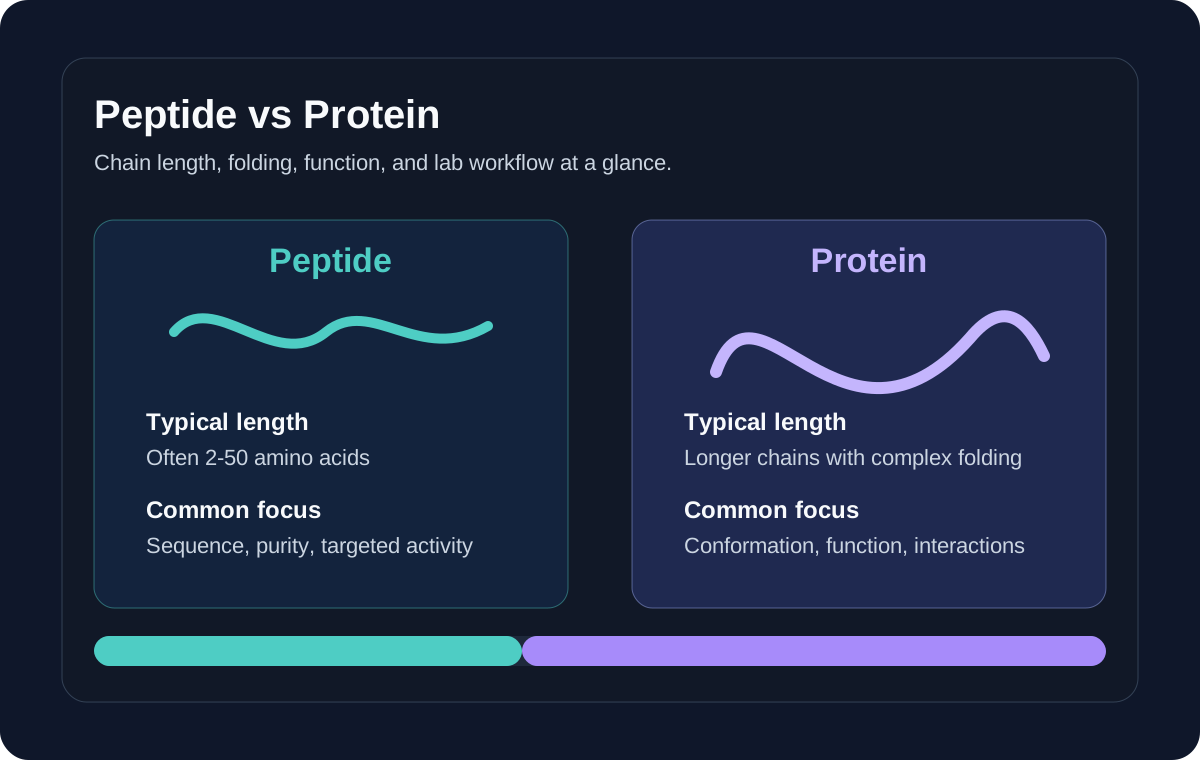
| Typical length | Short chains, often 2-50 amino acids | Longer chains, often greater than 50 amino acids |
| Structural complexity | May be linear or modestly folded | Often forms stable tertiary or quaternary structures |
| Functional range | Signaling, regulation, binding motifs | Catalysis, transport, structure, signaling, immunity, and more |
| Common lab focus | Synthesis, purity, sequence-specific activity | Folding state, conformation, interaction networks, function |
1) Chain Length Is a Rule of Thumb, Not an Absolute Law
In most educational settings, peptides are defined as short amino acid chains and proteins as larger chains with complex folding. The commonly used threshold is around 50 residues, but this is a practical convention rather than a strict biological law. You will find edge cases where classification depends on context, structure, or function.
For SEO and research readability, clarity matters more than rigid terminology. If a source emphasizes chain length and simple architecture, it usually points toward peptides. If it emphasizes stable three-dimensional structure and broad functional complexity, it usually points toward proteins.
Why this matters for interpretation
- Short sequences can still have strong biological effects.
- Longer chains are not automatically functional until proper folding occurs.
- Classification language can differ across biochemistry, pharmacology, and structural biology papers.
2) Folding and Higher-Order Structure Change the Conversation
The most important practical difference in peptide vs protein discussions is often folding. Proteins rely heavily on tertiary and quaternary organization, where non-covalent interactions, hydrophobic regions, electrostatics, and disulfide bonds shape activity. Peptides can adopt local motifs, but many do not require the same level of stable global architecture.
When researchers evaluate proteins, they often ask: does it fold correctly, maintain conformation, and preserve function under specific conditions? For peptides, the focus can be narrower: is the sequence correct, is purity high, and does it interact with the target system as expected?
3) Function Overlaps, but Scale and Context Differ
Both peptides and proteins can participate in signaling and regulation. The distinction is not that one is "active" and the other is not. Instead, proteins usually support broader and more complex responsibilities due to their size and fold complexity. Peptides are frequently used as targeted molecular tools or biologically active fragments with specific sequence-driven roles.
Examples researchers often discuss
- Peptides: short signaling molecules, receptor-binding motifs, synthetic probe sequences.
- Proteins: enzymes, antibodies, structural proteins, transport proteins, and receptor complexes.
4) Laboratory Workflows Also Diverge
Peptide projects often prioritize synthesis quality, batch consistency, and analytical purity. Protein studies frequently require additional steps such as expression systems, purification across multiple stages, and structural validation to confirm fold integrity.
Common analytical methods
- Peptide-focused: LC-MS, RP-HPLC, sequence confirmation, impurity profiling.
- Protein-focused: SDS-PAGE, Western blot, circular dichroism, NMR, X-ray crystallography, or cryo-EM depending on objective and scale.
Understanding these workflow differences helps you choose better keywords when searching scientific literature and improves interpretation of methods sections in publications.
Using the Distinction in Literature Search and SEO Intent
If you are searching papers or educational resources, query choice matters. "Peptide" queries usually surface synthesis, short-chain activity, and sequence optimization discussions. "Protein" queries often surface folding, domain architecture, and systems-level function. Combining both terms is useful when you need transition context between residue chemistry and higher-order structure biology.
For readers building foundational knowledge, the fastest route is to pair this page with Essential Amino Acids Guide for residue classification and Peptide Synthesis Methods for manufacturing/QC workflow context.
Frequently Asked Questions
Can a peptide be part of a protein?
Yes. Proteins are made from amino acid chains and can include peptide segments or motifs that contribute to function.
Are all proteins made from peptides?
Proteins are polypeptide chains with higher-order folding. In that sense, peptide bonds are fundamental to proteins, but not every peptide has protein-level complexity.
Is one category "better" than the other?
Neither is inherently better. They serve different scientific roles and should be evaluated based on research goals, sequence, structure, and assay context.
Continue the Topic Cluster
For deeper coverage, continue with these related pages: