
Essential Amino Acids Guide
Essential amino acids are a core search topic for anyone learning peptide and protein science. They are called "essential" because they must come from outside the body in nutrition contexts. In research and educational settings, these amino acids are also central to sequence design, structure analysis, and interpretation of biological function.
Primary resources for this topic
This page is a terminology and interpretation guide. Use the sources below when you need deeper residue-level context.
- PubMed search: essential amino acids and protein-structure reviews.
- PubMed search: amino-acid residue and side-chain chemistry reviews.
- Lot-specific COAs, HPLC data, and mass confirmation when a vendor uses amino acid terminology as a quality shortcut.
What Makes an Amino Acid Essential?
The term "essential" refers to biosynthetic limitation: an organism cannot produce enough of that amino acid internally to meet biological demand. That is different from saying one amino acid is more "important" than another in all contexts. Non-essential amino acids can still be critical in specific pathways or structural motifs.
In molecular biology education, this distinction helps students separate nutritional terminology from structural biochemistry. In peptide research, both essential and non-essential residues can strongly influence activity, stability, and interaction profiles.
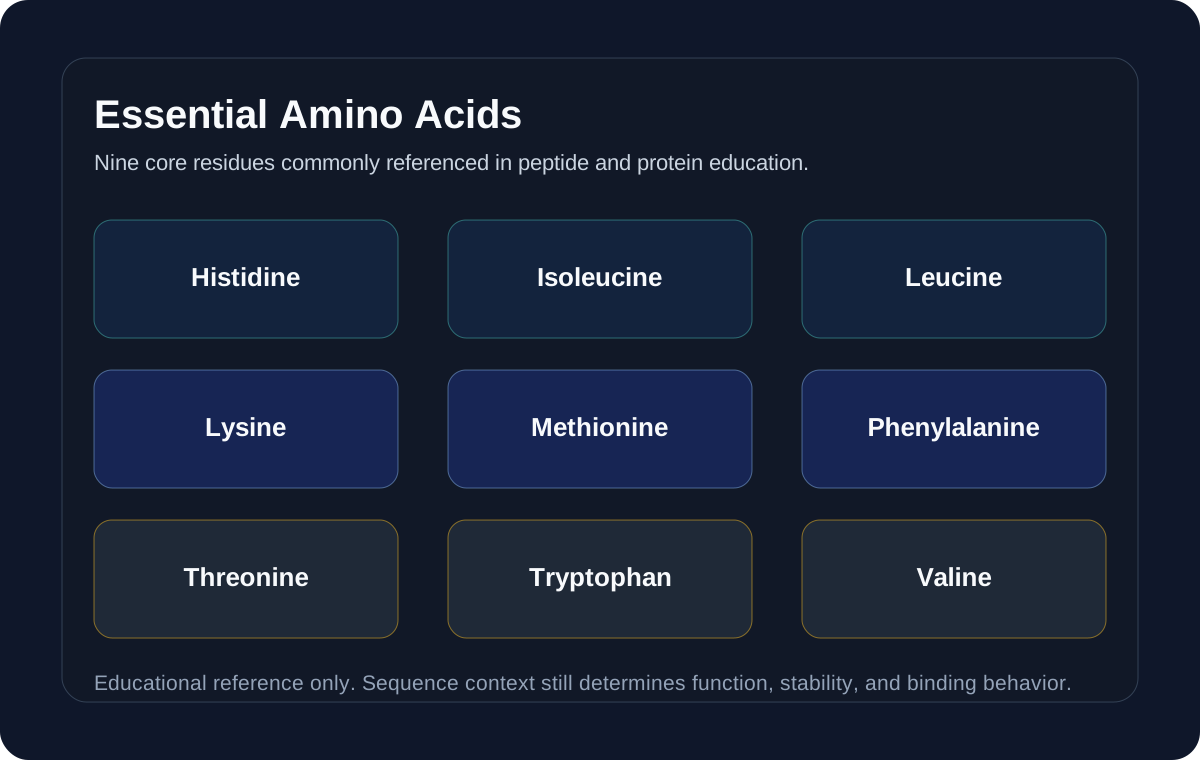
The Essential Amino Acid Set (Human Biology Context)
Imidazole side chain; relevant in pH-sensitive interactions.
Branched-chain residue; hydrophobic packing contributor.
Hydrophobic core support in many proteins.
Basic residue; common in binding and post-translational biology.
Sulfur-containing residue; often associated with initiation biology in translation.
Aromatic residue with strong hydrophobic character.
Polar residue; can influence hydrogen bonding and recognition surfaces.
Large aromatic side chain used in folding and fluorescence studies.
Branched-chain hydrophobic residue common in core packing.
This list is often the starting point for educational "essential amino acids" searches, but scientists still evaluate every residue in context of sequence and structure.
How Essential Amino Acids Influence Peptide and Protein Behavior
1) Sequence-level effects
Substituting even one residue can shift hydrophobicity, charge distribution, or steric profile. That can change solubility, stability, and interaction behavior in assay systems.
2) Structural effects
Residue identity influences secondary and tertiary tendencies. Aromatic and branched-chain residues frequently stabilize core regions, while polar/basic residues may shape interfaces and recognition surfaces.
3) Analytical effects
Residue composition can affect chromatographic behavior, ionization efficiency in mass spectrometry, and purification strategy. Understanding this helps interpret LC-MS and HPLC data more effectively.
How to Read Essential Amino Acid Claims in Research Content
Many pages discussing essential amino acids mix nutritional framing with molecular mechanism language. A better approach is to separate the claim type first: is the statement about dietary requirement, sequence design, analytical chemistry, or biological activity? That distinction prevents major interpretation errors when comparing educational articles, vendor pages, and primary literature.
When reviewing a source, check whether it defines the experimental model, concentration range, and measurement method. Claims about "importance" become meaningful only after context is clear. For example, a residue can be nutritionally essential yet only marginally relevant to a specific peptide-target interaction in one assay design.
- Check model context: Cell, animal, in vitro binding, or computational simulation.
- Check endpoint clarity: Binding change, signaling shift, stability effect, or analytical recovery.
- Check sequence specificity: Residue substitutions should be interpreted within full sequence architecture.
This process helps learners avoid oversimplified conclusions and improves topical authority by aligning content language with real scientific workflows.
Common Interpretation Mistakes to Avoid
A frequent SEO-era mistake is treating essential amino acids as a standalone quality score for peptides. In practice, quality and usefulness depend on sequence intent, purity documentation, method transparency, and how results were measured. Another common issue is assuming residue classes transfer directly across targets without confirming structural context.
For better educational accuracy, map each claim to one of three levels: terminology, mechanism, or application. Terminology explains what "essential" means. Mechanism explains how residue chemistry can influence structure and behavior. Application explains what was actually observed in a defined research setup.
Use this guide together with Peptide vs Protein and Peptide Synthesis Methods so users can connect amino acid terminology to chain architecture and practical lab workflows.
Common Search Questions, Answered Clearly
Are essential amino acids only relevant in nutrition?
No. While the term comes from nutritional physiology, the residues themselves are fundamental in molecular structure and function studies.
Do essential amino acids automatically make a peptide more active?
No. Activity depends on full sequence context, target binding dynamics, and experimental conditions, not one classification label.
Should educational guides separate essential and non-essential residues?
Yes. It helps users understand terminology quickly, then move into structure-function interpretation with less confusion.
Practical Use for This Site's Topic Cluster
This page supports users searching for foundational amino acid terminology. It also supports semantic relevance for the broader peptide education cluster by connecting residue-level concepts to peptide structure and research workflows.